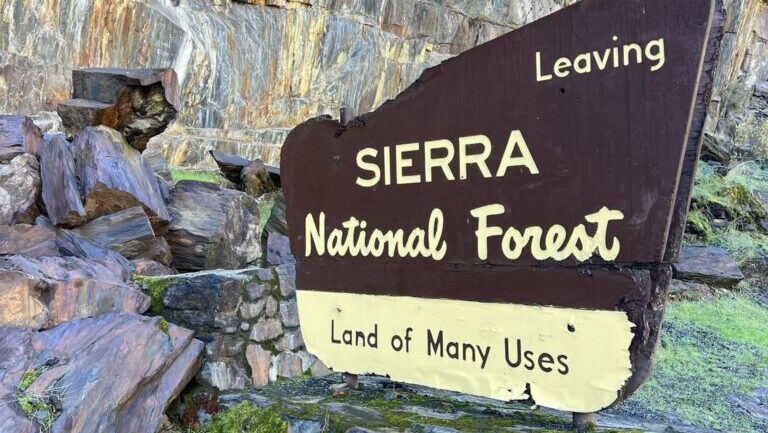
Our Backyard, Our Balance: Sierra National Forest Is Still the ‘Land of Many Uses’
For those of us who live in the mountain communities surrounding the Sierra National Forest, the forest isn’t just a destination—it’s part of daily life. It’s where we hike, fish, work, and find a sense of place. It’s also where a long-standing idea continues to shape what we see and experience every day: the “Land of Many Uses.”
That phrase isn’t just something you hear in passing—it reflects a philosophy that has defined this forest for well over a century, and one that still directly impacts how our communities live alongside it.
 A Forest Built on Use and Access
 A Forest Built on Use and Access
Sierra National Forest was officially established in 1893, at a time when the federal government began setting aside forest reserves to protect watersheds and manage natural resources. Unlike national parks, which were created primarily for preservation, national forests like ours were intended to be used.
From the beginning, this land supported logging operations that helped build California’s growing communities, along with grazing allotments that brought ranchers and their cattle into high-country meadows each summer. These weren’t seen as competing uses—they were part of the forest’s purpose.
When the United States Forest Service took over management in 1905, it reinforced that idea: these lands would be protected, but also actively used for the benefit of the public.
Defining the “Many Uses”
That approach was later formalized by Congress through the Multiple-Use Sustained-Yield Act of 1960, which directed national forests to be managed for multiple purposes—recreation, timber, grazing, watershed protection, and wildlife habitat.
Here in the Sierra, we don’t have to look far to see what that means.
It might look like driving past cattle grazing in a meadow on the way to a favorite fishing spot. It might mean sharing the road with logging trucks heading down the mountain. Or it might be as simple as a weekend at Bass Lake, surrounded by visitors enjoying the same forest we call home.
All of these uses—sometimes overlapping, sometimes competing—are part of what defines this place.
A Modern Balancing Act
Today, that balance feels more important—and more complicated—than ever.
Recreation has grown significantly, with more visitors coming to enjoy the forest’s trails, lakes, and access to nearby Yosemite. At the same time, the role of the forest in protecting our communities from wildfire has taken center stage.
Fuel reduction projects, controlled burns, and forest thinning are now a regular part of what we see on the landscape. While they may resemble traditional logging, many of these efforts are focused on reducing fire risk and protecting homes, infrastructure, and lives in our mountain towns.
Still, questions remain about how to balance these needs. Grazing, timber, recreation, and conservation all have a place here—but not always without tension. For those of us who live here, that balance isn’t theoretical. It’s something we experience firsthand.
Why the Phrase Still Matters
For our mountain communities, the “Land of Many Uses” is more than a guiding policy—it’s a reality we live with every day.
It’s why we can head out for a morning hike, spend the afternoon on the water, and still depend on the forest for our livelihoods, our water supply, and our safety during fire season. It’s why different groups—locals, visitors, ranchers, and resource managers—share the same space, often in different ways.
More than 130 years after its establishment, Sierra National Forest remains defined by that balance. The phrase “Land of Many Uses” still fits because it reflects what this forest has always been: a place meant to serve many purposes, and many people.
For those of us who call this area home, that’s not just history—it’s our everyday experience.