
The Stories Beneath Yosemite’s Headstones
Galen Clark prepared his own grave decades before he needed it. He selected a granite marker and planted young giant sequoias from the Mariposa Grove around his chosen resting place in Yosemite Valley. When he died in 1910, he was just days short of his 96th birthday. The trees became a living memorial to a man who helped protect their kind. The National Park Service recounts his life and burial preparations.
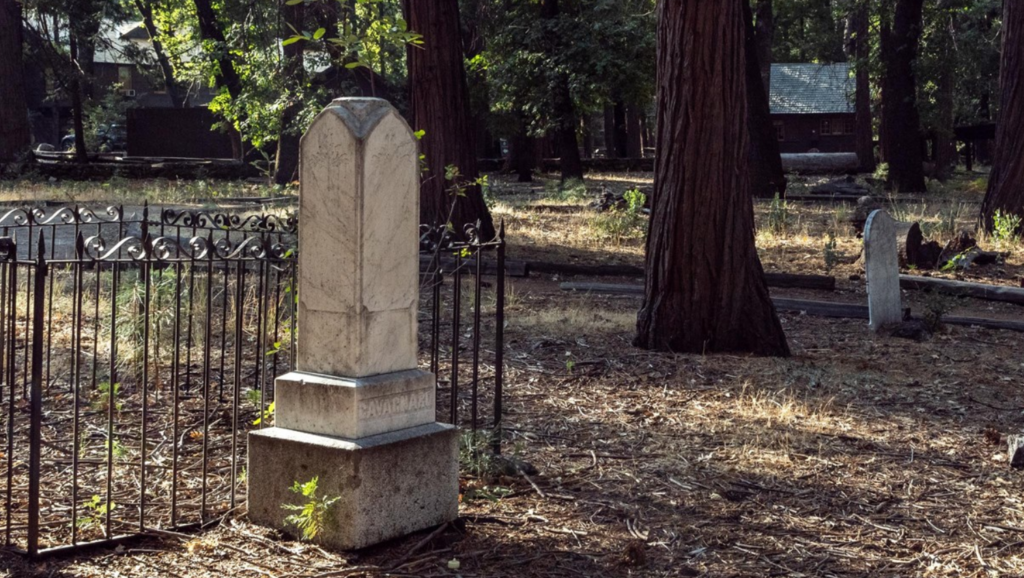
For a Halloween-season encounter with Yosemite’s past, the cemetery at the west end of Yosemite Village offers something deeply human: lives measured in work, adventure, family and loss. Its markers connect the celebrated landscape to people who called it home—and others whose visits ended there.
A guardian’s long life
Clark’s connection to Yosemite began with a visit in 1855. After a lung hemorrhage, he sought the mountain air and settled at Wawona in 1857. His stopping place supplied travelers with food, shelter and grazing for their horses.
He became the first guardian of the Yosemite Grant, the state-administered protection of Yosemite Valley and the Mariposa Grove that preceded today’s national park. His work ranged beyond welcoming visitors: in 1872, he helped John Muir place stakes in an ice field on Mount Maclure for glacial research. His gravesite brings that expansive life down to a personal scale—a chosen patch of ground and trees planted for the future. NPS’s biography traces those connections.
A daughter beyond the family name
James Mason Hutchings, the publisher and hotelkeeper who helped publicize Yosemite, is buried in Yosemite Cemetery, as is his daughter Florence. The family’s history includes the daily labor behind early tourism: Florence and her sister Gertrude helped with chores at the Hutchings House hotel. James later died in a wagon accident on the Big Oak Flat Road in 1902. NPS’s family history follows their complicated relationship with the Valley.
Florence’s own story deserves a pause. Born in 1864, she rode horses bareback, hiked and camped, and helped care for the Yosemite Valley Chapel as a teenager. She cleaned, arranged flowers and prepared hymn books for services. She died in 1881 at just 17. Mount Florence carries her name into the high country, while her grave preserves a more intimate connection to the Valley where she grew up. Yosemite Conservancy’s account describes her short, active life.
Lives beyond the familiar names
The cemetery also holds 11 known graves of Yosemite Native people. Among them is Lucy Brown, whom the Park Service identifies as a survivor of the Mariposa Battalion’s 1851 raid on Yosemite Valley. Her presence connects this burial ground to a history that reaches beyond tourism and park administration.
Other names reveal the range of people remembered in the cemetery: pioneering photographer George Fiske, Yosemite’s first chief ranger Forest S. Townsley, and Sadie Schaeffer, a Sentinel Hotel waitress who drowned in the Merced River in 1901. Together, these lives suggest a community sustained by many kinds of work. NPS’s cemetery introduction provides a starting point for learning about them.
The markers themselves have needed care. In 2014, NPS announced completion of a restoration supported by Yosemite Conservancy, including repairs to headstones, wooden monuments and wrought-iron fencing, along with walkway improvements. That preservation work helped keep these connections legible.
For those planning a quiet stop, NPS asks visitors to stay on designated paths. The surfaces are unpaved and irregular, and the cemetery is not wheelchair accessible. A guide is available to borrow or purchase at the Yosemite Valley Welcome Center, according to the park’s cemetery information page.
A name and two dates can seem like very little. Following the names on the cemetery headstones into the historical record reveals a much larger story of Yosemite.