
Living Alongside Wildlife: New California Law Focuses on Preventing Conflicts
The California Wildlife Coexistence Act lays out a statewide approach to helping people and wildlife share the landscape, with implementation dependent on funding.
A bear drawn to an unsecured trash can become more than an unexpected visitor. When wildlife finds food around homes, the encounters can repeat—and become increasingly difficult for both people and animals.
For mountain communities, preventing those problems is part of living close to wild places. Newly signed California legislation aims to strengthen the state’s ability to help.
Senate Bill 1135, authored by Sen. Catherine Blakespear, establishes a framework for a California Wildlife Coexistence Program within the Department of Fish and Wildlife. Gov. Gavin Newsom signed the measure, according to an announcement from Defenders of Wildlife, which co-sponsored it with the National Wildlife Federation.
The legislation emphasizes practical, science-based ways to prevent and reduce conflicts through nonlethal methods. Its provisions include responding to wildlife calls, investigating incidents, providing technical assistance and supporting community efforts. Establishing the program depends on funding appropriated by the Legislature. Read the legislation.
The effort builds on a previous statewide program that ended in 2024 after its funding expired. According to Blakespear’s office, that program operated for three years and deployed trained regional staff to address human-wildlife conflicts.
Her office also reported that, over the preceding five years, wildlife incident reports to CDFW increased 31%, while calls, emails and field contacts rose 58%. Those figures describe statewide demand for assistance, rather than a measured increase specific to Madera or Mariposa counties. Background from the bill author’s office.
For residents of bear country, the underlying approach may sound familiar: address what brings an animal into conflict before the behavior becomes established.
CDFW identifies access to food as a central factor in human-bear conflicts. Garbage, pet food and other attractants can encourage bears to return to developed areas. Bears that become accustomed to people or dependent on human food may grow bolder or cause property damage.
Removing those food sources and using bear-resistant storage are examples of preventive measures already recommended by the department. These are existing practices that illustrate the approach, rather than newly announced local services. CDFW’s bear-conflict guidance.
The legislation also addresses livestock producers. It formalizes a wolf-livestock coexistence and compensation program, with provisions for nonlethal deterrence, verified losses and indirect impacts. Those resources also depend on legislative appropriations and eligibility requirements.
Other provisions call for a technical advisory committee representing interests including rural communities, agriculture, public safety, tribal knowledge and wildlife science. Public reporting would help residents track incidents, responses and program spending. Official bill text.
Defenders of Wildlife’s California program director, Pamela Flick, welcomed the signing and said the organization looks forward to working with CDFW, farmers, ranchers and communities on coexistence strategies.
For the mountain area, the potential benefit is practical: more coordinated help protecting people, property and animals while preserving the wildlife that is part of living here. How that assistance takes shape will depend on the funding and implementation that follow.
———-
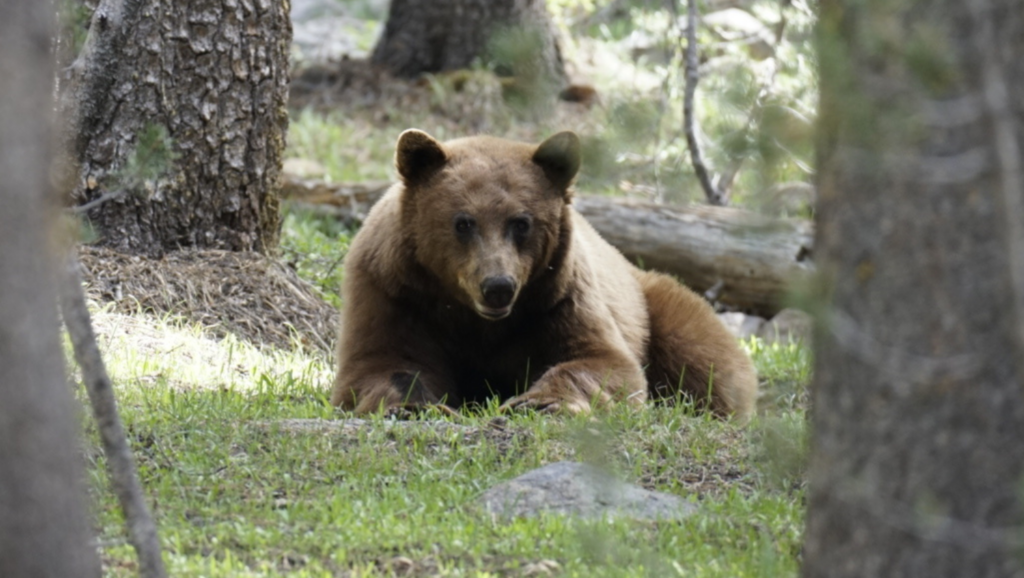
Feature Photo: A bear rests in Yosemite National Park. California’s new Wildlife Coexistence Act emphasizes preventing conflicts between people and wildlife.
Photo credit: NPS Photo / Robert Lester